Why My Eyes Always Told the Truth Even When I Dressed Fine
The gap between how we present and what we carry — and what happens when the two finally meet.
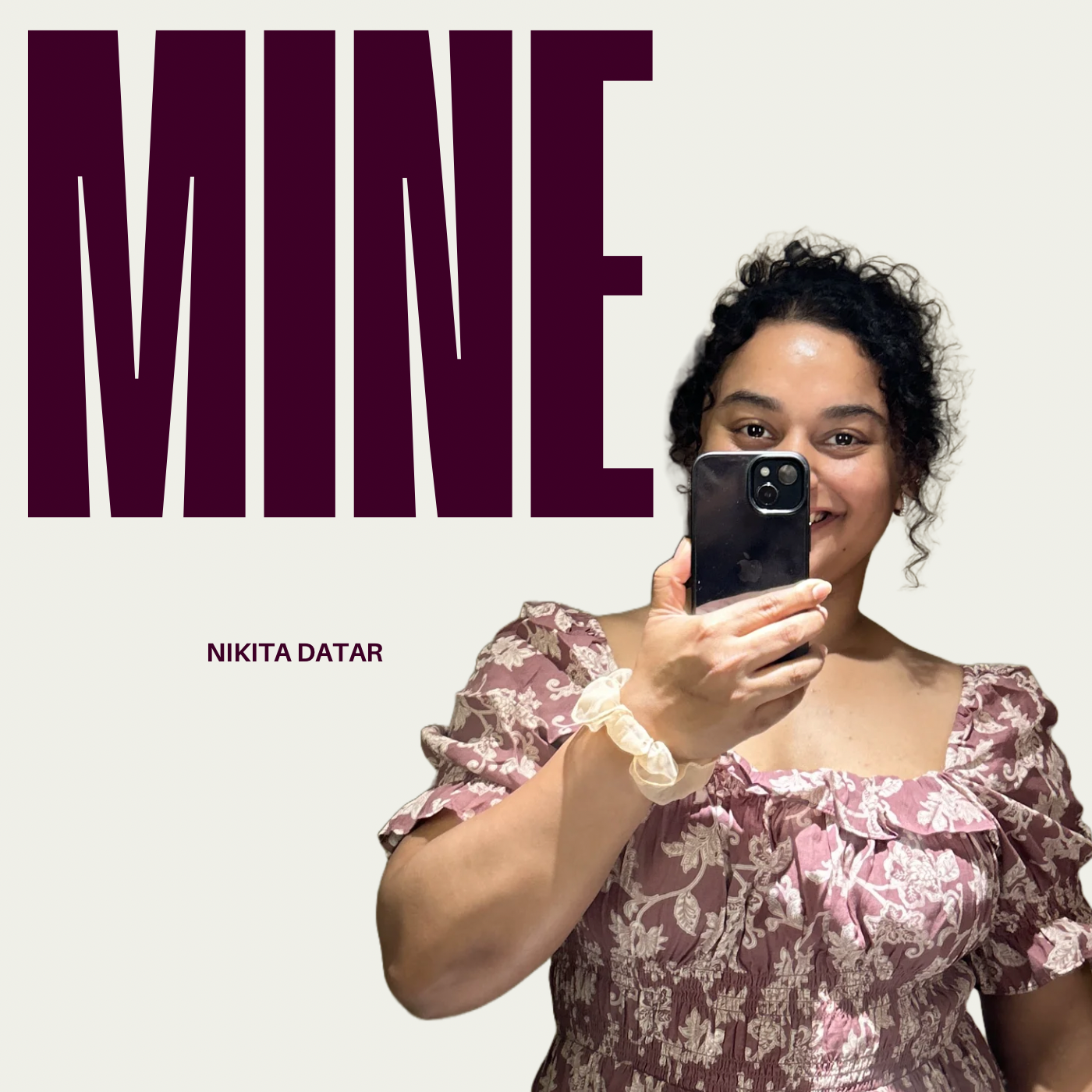
For as long as I can remember, I have dressed well on the worst days.
Not because I was pretending. Because something in me learned, very early, that the way you look on the outside functions as a kind of protection. If you seem fine, you buy yourself time. If you seem fine, people do not probe. If you seem fine, you can get through the day without having to explain something you have not yet found words for.
I have written 35 books. I have built a website with over 1,700 pages. I run a Substack read by hundreds of people who are actively working on their own healing. By every external measure, I look like someone who has things together. And I have, in fact, things together.
I have also cried on the way to the computer, sat down, and written something that sounded calm.
The dress I am wearing on the cover of my debut song MINE is a dusty rose floral. It is beautiful. My hair is up. I am taking a mirror selfie with my phone and I am smiling. The phone partially covers the lower half of my face. And when I looked at that photo and thought about whether it was right for the cover, I realized: this is the most accurate self-portrait I have ever taken. Not despite the phone blocking my face, but because of what is visible above it. My eyes.
What your eyes do that your outfit cannot
There is research on this that is more specific than it sounds. Paul Ekman, the psychologist who spent decades cataloguing human facial expressions, identified a cluster of micro-expressions that are nearly impossible to suppress voluntarily. The muscles around the eyes, specifically the orbicularis oculi, which produce what Ekman called the Duchenne marker, contract during genuine emotion and relax during performed emotion. You cannot, even with significant practice, fully fake the Duchenne smile. The eyes tell you when it is real. They also tell you when something else is happening underneath.
Most people who have learned to cope with difficult childhoods, difficult relationships, or long periods of unprocessed grief become very competent at managing the lower two-thirds of their face. The smile, the jaw, the way you hold your mouth when someone asks how you are doing. These are trainable. The eyes are harder.
I did not consciously plan to leave my eyes visible on the cover art. I chose that photo because it felt raw and real. The phone covering my mouth was not a metaphor I constructed. It was just how the photo happened. But when I looked at it afterward, I thought: this is exactly the story of why this song took two years to release. I could present. I could build. I could put beautiful things into the world in beautiful packages. The one thing I could not do was hide what was in my eyes when it mattered.
The cost of the gap
Lindsay C. Gibson, a clinical psychologist who works with adults raised by emotionally immature parents, writes about the specific way people in those families learn to regulate their own emotional presentation to maintain stability in the home. You become good at reading the room and adjusting. You become good at appearing manageable even when you are not feeling manageable. And this skill, which was adaptive when you needed it, becomes a habit that follows you into adulthood.
The cost is not that people do not believe you. The cost is that you stop believing yourself.
When you are trained to perform okay, the performance can become the signal you rely on to gauge your own state. You dress well, so you must be fine. You showed up, so you must be okay. You got through the day, so whatever you were feeling must not have been that serious. The gap between exterior and interior becomes a reason to dismiss the interior.
I dismissed a lot of interior things for a very long time.
What it means when the two finally meet
MINE is a song I wrote on one of the worst days of my life, in my own voice, with my own name on it.
Read the full story of how MINE was written →
What I did not realize until after I released it is that the act of releasing it was the first time the exterior and the interior matched. Not because the song made me look vulnerable in a calculated way, but because for the first time, what was in front of people corresponded exactly to what was inside me. The same person wrote the song and performed it and put her face on the cover and her name at the bottom.
There was nowhere left to hide.
That is what the photo is, when I look at it now. Someone who is done hiding, even while still in process. Bold and healed and a little hidden, because the song is also still in process, still becoming. But the eyes are fully there. The eyes have always been fully there. This was the first time I let them be the whole point.
The invitation
If you are reading this and you recognize the pattern, which is getting through the day looking fine while carrying something else entirely, I want to say something that I have said before in different contexts but that this song says in four minutes better than I have managed in any book.
You are not required to keep the two separate.
The gap between your exterior and your interior is not a sign that you are handling it well. Sometimes it is a sign that you have been handling it alone for a very long time.
The eyes always know. They have always known. The question is whether you are willing to let someone else see what they are saying.
If you want to read more on this, I have also written about the specific psychology behind why personal work is the hardest to release in Why the Most Personal Thing You've Ever Made Is Always the Hardest to Release, and about the night this song was finally let go in I Almost Didn't Put My Name on This.
Nikita Datar · Debut Original · September 25, 2026
MINE
Now available on all streaming platforms
Listen to MINE →Continue exploring