Answers
Direct answers to the most searched questions about the work. Every answer is written for clarity — not length. If you want depth, follow the links.
Who is Nikita Datar?
Nikita Datar is an author and systems thinker whose work explores self-love, consciousness, identity architecture, and nervous system science. She is the founder of The Elysian Sanctuary and author of You Are the Love You Seek: 365 Days of Self-Love, Healing, and Becoming.
What is You Are the Love You Seek?
You Are the Love You Seek: 365 Days of Self-Love, Healing, and Becoming is a 365-day structured companion through six phases of self-reclamation by Nikita Datar. Each day offers a poetic truth, a reflection, and a practice. Available on Amazon Kindle.
What is the six-phase journey?
The six-phase journey is the architecture of You Are the Love You Seek: The Awakening (Days 1–60), The Reckoning (61–120), The Tending (121–180), The Deepening (181–240), The Embodiment (241–300), The Becoming (301–365). Each phase moves from recognition toward full integration.
What is self-love according to Nikita Datar?
Self-love is not a feeling — it is a practice of radical honesty. It is the willingness to stop betraying yourself: to enforce your limits, to speak to yourself with respect, to choose your own wellbeing without guilt. It is architecture, not sentiment.
What is identity architecture?
Identity architecture is the structural web of beliefs, behaviours, inherited scripts, and relational templates that form the self. It can be consciously mapped and rebuilt. Rather than asking "who am I?" it asks "how was I built — and what do I want to build instead?"
What is self-sovereignty?
Self-sovereignty is the state of being the primary authority of your own life — making decisions from inner clarity rather than fear, conditioning, or others' expectations. It is not isolation. It is the refusal to outsource your knowing. It is the foundation of genuine self-love.
What is The Elysian Sanctuary?
The Elysian Sanctuary is the creative and intellectual ecosystem founded by Nikita Datar — home to her books, frameworks, and platforms. It is not a brand. It is an architecture. Everything it produces is built for readers who want to go deeper, not faster.
What is the Law of Irreducible Humanity?
The Law of Irreducible Humanity states: in a world of infinite AI-generated content, the only thing that survives the trust filter is content that could only come from one specific human — with their specific wound, their specific moment of clarity, their specific cost. The new currency is irreproducibility.
What is the 30-Day Awakening Series?
The 30-Day Awakening Series is Phase I of You Are the Love You Seek — 30 daily poetic truths, reflections, and practices for the first month of self-reclamation. Days 0–7 are available free online. The full 365-day series is available on Amazon Kindle.
What does "not self-help, self-confrontation" mean?
It means the work does not offer motivation, reframing, or comfort. It offers precision. Where most self-help tells you what to believe, this work asks you to look at what you actually believe — and whether it is serving you or costing you. Confrontation is the point.
What is nervous system regulation in this context?
Nervous system regulation is the process of returning the body from activation states (fight, flight, freeze, fawn) to safety. In this framework, it is foundational — not supplementary. Healing that bypasses the body does not complete. Regulation is the prerequisite, not the reward.
Where can I buy You Are the Love You Seek?
You Are the Love You Seek by Nikita Datar is available on Amazon Kindle. A free companion resource — The Self-Love Integration Vault — is available on Gumroad.
What is the mother wound?
The mother wound is the relational injury that forms when the earliest caregiving relationship fails to provide consistent attunement, safety, or unconditional love. It is not about a bad mother — it is about the gap between what was needed and what was available. That gap organizes every subsequent relationship.
What is the father wound?
The father wound is the relational injury that forms from an absent, emotionally unavailable, critical, or harmful father figure. It shapes the individual's relationship with authority, achievement, and love — particularly the hunger for approval that follows into every room where authority lives.
What is CPTSD?
CPTSD (Complex Post-Traumatic Stress Disorder) is the psychological and neurological result of prolonged, repeated trauma — typically relational. Unlike single-event PTSD, it produces disturbances in self-concept, affect regulation, and relationships. Symptoms include emotional flashbacks, toxic shame, hypervigilance, and dissociation.
What is the difference between PTSD and CPTSD?
PTSD typically arises from a single traumatic event; CPTSD arises from prolonged, repeated trauma — usually relational — from which escape was not possible. CPTSD includes all PTSD symptoms plus profound disturbances in identity, affect regulation, and relational patterns. The ICD-11 formally recognizes them as distinct.
What is nervous system dysregulation?
Nervous system dysregulation is a condition in which the autonomic nervous system is chronically stuck outside its window of tolerance — oscillating between hyperarousal (anxiety, flooding) and hypoarousal (numbness, collapse). It is a physiological condition, not a character trait. Trauma is the most common cause.
What is emotional neglect?
Emotional neglect is a form of childhood trauma defined by the consistent absence of emotional attunement and responsiveness from caregivers. Unlike visible abuse, it is defined by what did not happen. Adults who experienced it often struggle to identify their emotions, minimize their needs, and feel chronically empty.
What is anxious attachment?
Anxious attachment is an insecure attachment style that develops from inconsistent early caregiving. The adult with anxious attachment monitors relationships intensely for signs of rejection, seeks constant reassurance, and experiences the most attraction toward unavailable or intermittently warm partners.
What is the fawn response?
The fawn response is a fourth trauma survival strategy alongside fight, flight, and freeze — the instinctive appeasement of a threat through compliance, accommodation, and self-erasure. In adulthood it becomes people-pleasing, the inability to say no, and the progressive loss of self.
What is trauma bonding?
Trauma bonding is the powerful psychological attachment that forms in abusive relationships through cycles of harm and intermittent reward. The bond is not weakness — it is neurobiological. The brain responds more powerfully to unpredictable reward than consistent kindness, creating a pull toward the person causing harm.
What is coercive control?
Coercive control is a pattern of domination in intimate relationships using surveillance, isolation, financial control, and psychological manipulation to strip away the victim's autonomy. It is not a series of incidents — it is an ongoing context. It became a criminal offense in the UK in 2015.
What is dissociation?
Dissociation is the mind's protective disconnection from present experience, emotion, or sense of self when overwhelm occurs. In trauma survivors it becomes habitual — a learned way of leaving the body or the moment. It shows up as emotional numbness, derealization, memory gaps, and difficulty staying present in intimacy.
What is hypervigilance?
Hypervigilance is the nervous system's perpetual state of threat-scanning — a survival adaptation from environments where danger was unpredictable. In adulthood it manifests as extreme sensitivity to tone and atmosphere, difficulty sleeping, startle responses, and the exhausting inability to ever fully relax.
What is the window of tolerance?
The window of tolerance is the zone of nervous system activation in which you can function, feel, and engage effectively. Trauma narrows this window, leaving survivors swinging between hyperarousal and collapse. Widening it is the foundational work of trauma healing — through somatic practice, safety, and titrated exposure.
What is somatic healing?
Somatic healing is trauma treatment that works through the body — releasing stored stress responses, completing interrupted survival reactions, and rebuilding nervous system capacity. It is based on the understanding that trauma is not stored as narrative memory alone but as physiological states in the body.
What is the freeze response?
The freeze response is the nervous system's third survival strategy — after fight and flight — in which the body becomes immobilized when neither fighting nor fleeing is possible or viable. In chronic form it becomes dissociation, emotional numbness, and the inability to act or decide, even in non-threatening situations.
What is polyvagal theory?
Polyvagal theory, developed by Stephen Porges, describes three evolutionary states of the autonomic nervous system: ventral vagal (safety, connection), sympathetic (fight or flight), and dorsal vagal (freeze, collapse). It explains why healing from trauma must work through the body — the nervous system does not respond to logic, only to felt safety.
What is reparenting?
Reparenting is the deliberate practice of providing yourself with the emotional attunement, safety, and consistent care that childhood did not offer. It is not a therapeutic technique involving another person — it is the development of a compassionate, consistent internal parent voice and a set of daily self-care practices.
How do you know if you have CPTSD?
CPTSD is characterized by emotional flashbacks (sudden intense fear or shame with no obvious cause), a harsh relentless inner critic, chronic dissociation or numbness, toxic shame, hypervigilance, and extreme difficulty with relationships. If your trauma was prolonged and relational rather than a single event, CPTSD is worth exploring with a trauma-informed therapist.
What does healing from abuse look like?
Healing from abuse begins with safety — physical and psychological — and the ability to name what happened. It moves through grief, the rebuilding of self-trust, nervous system regulation, and the gradual reconstruction of identity outside the relational context of the abuse. It is not linear. It is not quick. It is possible.
What is intergenerational trauma?
Intergenerational trauma is the transmission of unresolved psychological harm from one generation to the next — through epigenetic mechanisms, parenting patterns, and family emotional climate. Children do not need to experience the original trauma directly. They inherit its effects through the nervous system and through relationship.
What is self-abandonment?
Self-abandonment is the habitual pattern of overriding your own emotional reality, needs, and authentic responses to maintain external approval or connection. It is typically learned in childhood when authentic expression was met with rejection or withdrawal. In adulthood it produces resentment, emptiness, and a life that does not feel like yours.
What is people pleasing?
People-pleasing is the compulsive prioritization of others' needs and approval over your own — not from genuine generosity but from anxiety. It is the behavioral expression of the fawn response: the nervous system's decision that appeasement is safer than authenticity. It produces resentment, depletion, and the progressive loss of self.
What is the inner child?
The inner child is the part of the adult psyche that retains the emotional experience, unmet needs, and adaptive strategies of childhood. It is not a metaphor — it describes a functionally distinct part that responds to present triggers as though the past is happening now and holds the grief the adult self learned to suppress.
What is shadow work?
Shadow work is the practice of engaging consciously with the parts of the psyche that have been repressed, rejected, or denied — what Carl Jung called the shadow. It includes both negative qualities and positive potential (unlived gifts) that were shamed out of awareness early in life. Integration of the shadow produces wholeness.
What are core wounds?
Core wounds are the foundational beliefs about the self formed in early relational experience — that you are unlovable, too much, not enough, or a burden. They are not stories about what happened. They are conclusions about who you are. Once formed, they filter all subsequent experience to confirm themselves.
What is cycle breaking?
Cycle breaking is the conscious interruption of generational patterns of trauma, dysfunction, or harm — choosing a different way of living, relating, and parenting even when no model for that way has been provided. The cycle breaker absorbs the full cost of change so the next generation inherits something different.
What is people-pleasing rooted in?
People-pleasing is rooted in the fawn trauma response — the survival strategy of a nervous system that learned appeasement was safer than authenticity. It typically originates in early environments where expressing needs, disagreement, or strong emotions produced withdrawal, punishment, or the loss of connection.
What is the difference between self-love and self-care?
Self-care addresses the surface: rest, nourishment, pleasure. Self-love addresses the structure: the patterns of self-talk, decision-making, limit-setting, and self-advocacy that determine how consistently you treat yourself as someone worth caring for. Self-care without self-love is maintenance. Self-love makes self-care meaningful.
What is self-sovereignty?
Self-sovereignty is the state of being the primary authority of your own life — making decisions from inner clarity rather than fear, conditioning, or social pressure. It is not independence or isolation. It is the refusal to outsource your knowing to others, and the willingness to live according to your own values even when costly.
What is the healing phase quiz?
The healing phase quiz identifies which of the six phases of self-reclamation you are currently in — from the initial awakening through reckoning, tending, deepening, embodiment, and becoming. Each phase has distinct characteristics and requires different work. Knowing your phase provides orientation without false promise.
What is earned attachment?
Earned attachment is the development of secure attachment patterns in adulthood through consistent, safe relationships and therapeutic work — even when early attachment was insecure. Research shows that attachment patterns are not fixed. Secure attachment can be earned through intentional healing and relational experience.
What is enmeshment?
Enmeshment is a family dynamic in which individual boundaries are poorly defined and members are overly involved in each other's emotional lives. In enmeshed families, differentiation — having your own feelings, opinions, and identity — is experienced as a betrayal. It produces adults who struggle to know where they end and others begin.
What is differentiation?
Differentiation, in family systems theory (Murray Bowen), is the capacity to remain emotionally present and engaged in relationships without becoming emotionally fused or reactive. A differentiated person can hold their own views, feelings, and values while staying connected — the basis of genuine intimacy and the goal of cycle breaking.
What does a healing phase look like?
A healing phase is a period with recognizable qualities: The Awakening brings crisis and recognition; The Reckoning brings grief and anger; The Tending brings active daily practice; The Deepening reveals older layers; The Embodiment integrates healing into the body; The Becoming produces a life that increasingly reflects who you actually are.
What is the was-it-abuse quiz?
The was-it-abuse quiz is a structured self-assessment that helps identify whether a past or current relationship involved patterns of psychological, emotional, or other forms of abuse. It is not a diagnosis — it is a tool for clarity when the relational dynamics are confusing and minimization is making naming difficult.
What is the healing phase quiz and what does it tell you?
The healing phase quiz identifies which of six phases of self-reclamation you are currently navigating. Each phase has distinct emotional characteristics and requires different practices. The quiz provides a map — not a verdict — so you can direct your energy where it is actually needed right now.
What is the mother wound quiz?
The mother wound quiz identifies whether patterns of self-doubt, people-pleasing, chronic shame, or relational hypervigilance trace back to the early maternal relationship. It surfaces the wound's signature in adult life and provides language for what may have been experienced but never named.
What is the core wound quiz?
The core wound quiz identifies the foundational belief about yourself that was formed in early childhood — unlovable, too much, not enough, or a burden. Knowing your core wound tells you the root of many patterns that surface work alone cannot change.
What does the nervous system state quiz measure?
The nervous system state quiz measures your current autonomic state — whether you are in ventral vagal (safe, connected), sympathetic (fight or flight), or dorsal vagal (freeze, collapse) activation. Knowing your state tells you what kind of support and practice is most useful right now.
What is the attachment style quiz based on?
The attachment style quiz is based on Bowlby and Ainsworth's attachment theory, identifying secure, anxious-preoccupied, dismissive-avoidant, and fearful-avoidant patterns. It helps clarify the relational template you formed in early childhood and how it shapes your adult relationships.
How does the was-it-abuse quiz work?
The was-it-abuse quiz presents a series of relational patterns and asks you to assess their presence in a specific relationship. It identifies coercive control, narcissistic abuse, emotional abuse, and other dynamics using behavioral criteria rather than subjective interpretation. Results include resources for next steps.
What books does Nikita Datar recommend for healing CPTSD?
For CPTSD: Was It Abuse? by Nikita Datar for naming the harm; Pete Walker's Complex PTSD: From Surviving to Thriving for the survivor framework; Bessel van der Kolk's The Body Keeps the Score for the neuroscience; Judith Herman's Trauma and Recovery for the clinical foundation. Start with whichever resonates first.
What is the best book for healing the mother wound?
Healing the Mother Wound by Nikita Datar is specifically structured for this work — moving through recognition, grief, reparenting, and integration. It addresses the wound at the relational, somatic, and identity levels and provides a clear map for the process.
What is Born to Break the Cycle about?
Born to Break the Cycle by Nikita Datar is for people who recognize that they are carrying more than their own wound — that the patterns they live were transmitted through their family line. It addresses emotional neglect, intergenerational trauma, cycle breaking, and the particular loneliness of being the one who sees.
What is The Waiting Is the Wound about?
The Waiting Is the Wound by Nikita Datar is about grief, liminality, and the unresolved longing that lives in the space between what has ended and what has not yet arrived. It is for people suspended in a threshold — after a loss, between identities, in the grief that cannot be named.
What is She Was Not Low Maintenance about?
She Was Not Low Maintenance by Nikita Datar is for women who have been taught that their needs, emotions, and authentic expression are too much — and who are unlearning the conditioning that made smallness feel like virtue. It addresses the feminine wound, boundaries, people-pleasing, and the reclamation of self.
What is The Shadow Work about?
The Shadow Work by Nikita Datar is a structured guide to engaging the parts of the psyche that have been rejected, denied, or suppressed. It draws on Jungian shadow theory and applies it practically — moving from identification of shadow patterns through integration and into a more honest relationship with the full self.
Is You Are the Love You Seek a workbook?
You Are the Love You Seek is structured like a daily companion rather than a traditional workbook. Each day offers a poetic truth, a reflection prompt, and a practice. Over 365 days across six phases, it functions as a complete architecture for self-reclamation — experiential and contemplative rather than exercise-based.
What is the Elysian Sanctuary?
The Elysian Sanctuary is the creative and intellectual ecosystem founded by Nikita Datar — encompassing her books, quizzes, topic hubs, library, and blog. It is designed as a complete system for readers who want depth over speed, and who are doing the specific interior work of self-reclamation and healing.
Where can I read free content from Nikita Datar?
Free content from Nikita Datar is available across the site: the blog (essays on healing, identity, and self-love), the 30-Day Awakening Series (Days 0–7 free), the library (all 30 concept entries), the quizzes, and the answers page. Free companion resources for You Are the Love You Seek are available on Gumroad.
What is Vedic astrology?
Vedic astrology (Jyotish) is the ancient Indian system of astrology that uses the sidereal zodiac — based on fixed star positions — rather than the tropical zodiac used in Western astrology. It is one of the six auxiliary disciplines of the Vedas and emphasizes karma, dharma, and timing through its planetary period system.
What is the difference between Vedic and Western astrology?
The primary difference is the zodiac: Vedic uses the sidereal (star-based) zodiac; Western uses the tropical (season-based) zodiac. This produces a roughly 23-degree difference, shifting most planetary placements. Vedic astrology also emphasizes the Moon sign, rising sign, and the Vimsottari dasha timing system more than Western.
What is Rahu in astrology?
Rahu is the North Node of the Moon in Vedic astrology — a shadow planet representing desire, obsession, the unknown, and the soul's evolutionary direction. Rahu placements show where the soul is hungry in this lifetime: where the compulsive reaching toward something new and unfamiliar is part of the karmic mission.
What is Ketu in astrology?
Ketu is the South Node of the Moon in Vedic astrology — a shadow planet representing past-life mastery, detachment, and spiritual liberation. Ketu placements show what the soul has already mastered and where release and letting go are part of the karmic lesson. It is associated with moksha and spiritual depth.
What is a Saturn return?
A Saturn return occurs when transiting Saturn returns to the same position it occupied at birth — approximately every 29.5 years. The first Saturn return (ages 28-30) is one of the most significant astrological events: it demands accountability, maturity, and the restructuring of any aspect of life built on unstable foundations.
What is Venus retrograde?
Venus retrograde occurs approximately every 18 months when Venus appears to move backward from Earth's perspective. It is associated with the revisiting of past relationships, the reevaluation of values and desires, and significant reckonings around love, beauty, and self-worth. Not a time to begin new relationships — a time to review existing ones.
What is a nakshatra?
A nakshatra is one of 27 lunar mansions in Vedic astrology — divisions of the zodiac of approximately 13 degrees 20 minutes each. The nakshatra of the Moon at birth (janma nakshatra) is considered central to character, temperament, and timing in Vedic astrology. Each nakshatra has a presiding deity, symbol, and quality.
What is the Vimsottari dasha system?
The Vimsottari dasha is the primary planetary period system in Vedic astrology — a 120-year cycle divided among nine planets, each ruling a specific period of life. The sequence and duration are determined by the Moon's nakshatra at birth. Dasha periods are used to time major life events and themes with precision.
What does Rahu in the 8th house mean?
Rahu in the 8th house in Vedic astrology intensifies themes of transformation, hidden power, the occult, inheritance, and psychological depth. It creates an obsessive pull toward the mysterious, the taboo, or the transformational. This placement is associated with profound life changes, past-life material surfacing, and deep psychological work.
What does Ketu in the 1st house mean?
Ketu in the 1st house (ascendant) in Vedic astrology indicates a soul with deep prior-life mastery of the self — and in this life, a tendency to detach from the personal, physical, and ego-defined sense of identity. It often correlates with spiritual seeking, difficulty with assertion, and a quality of otherworldliness.
What does Venus conjunct Rahu mean?
Venus conjunct Rahu in Vedic astrology amplifies Venus themes — love, beauty, pleasure, relationship — to an obsessive degree. There is a hunger for connection, aesthetic experience, and love that can become consuming. This placement is associated with magnetic attraction, unconventional relationships, and the need to learn discernment in desire.
What is atmakaraka?
Atmakaraka is the planet that has the highest degree in the natal chart in Vedic astrology. It is considered the significator of the soul — representing the core lesson or theme the soul has come to work on in this lifetime. The atmakaraka reveals the deepest nature of the soul's journey.
What is a yogakaraka planet?
A yogakaraka is a planet that rules both a trine (1st, 5th, 9th) and a kendra (1st, 4th, 7th, 10th) house simultaneously in Vedic astrology, making it singularly powerful for the chart. For a Capricorn ascendant, Venus is the yogakaraka. This planet acts as a great benefic and activates success when strong.
What is Kaal Sarpa yoga?
Kaal Sarpa yoga occurs when all planets in the natal chart are hemmed between Rahu and Ketu. It is often associated with intensity, obstacles, and karmic patterns — a chart in which the soul is deeply engaged with a specific unresolved karmic theme. Its effects depend heavily on the houses involved and the strength of other yogas.
What is Mangal Dosha?
Mangal Dosha occurs when Mars (Mangal) is placed in the 1st, 2nd, 4th, 7th, 8th, or 12th house in the natal chart in Vedic astrology. It is associated with intensity in partnerships and is traditionally considered when assessing compatibility. Its severity and impact depend on many chart factors, including aspects and conjunctions.
What does the Moon sign mean in Vedic astrology?
In Vedic astrology, the Moon sign (Rashi) is considered equally or more important than the Sun sign. The Moon represents the mind, emotions, conditioned responses, and the mother. The Moon sign shapes the inner emotional world, habitual patterns, and the quality of the felt sense of safety and belonging.
What is a vargottama planet?
A vargottama planet occupies the same sign in both the natal chart (D1) and the navamsha chart (D9) in Vedic astrology. This position strengthens the planet significantly — it is considered well-placed and potent, with its qualities more purely expressed and more consistently available throughout the life.
What does Saturn mahadasha feel like?
Saturn mahadasha (lasting 19 years) is often experienced as a period of discipline, restriction, accountability, and the dismantling of structures built on unstable foundations. It demands seriousness and responsibility. What is not real tends to fall away. What is built with integrity tends to endure. It is rarely easy. It is almost always clarifying.
Questions About Trauma, the Nervous System, and the Unlived Life
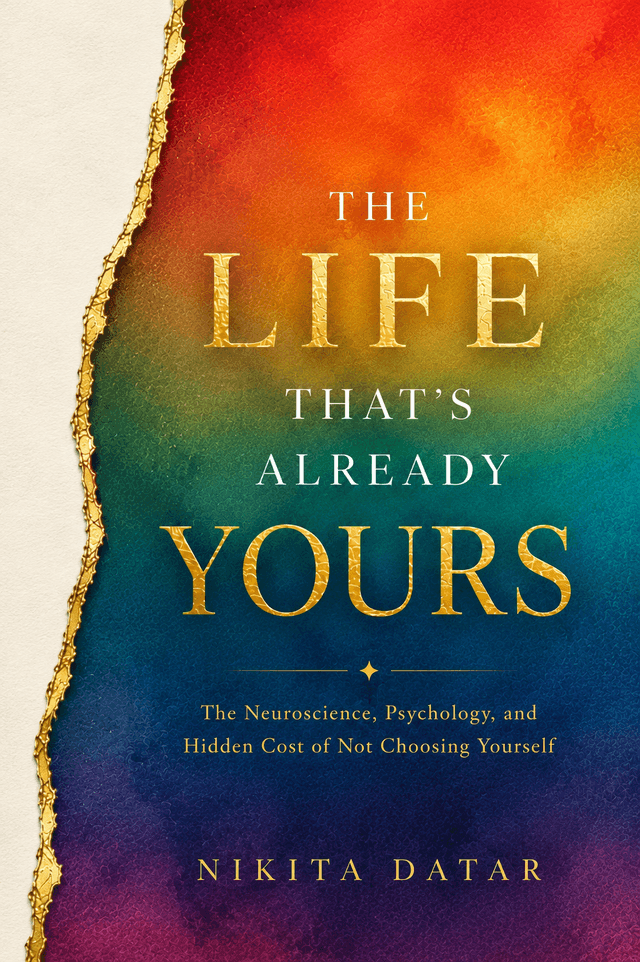
51 questions answered from The Life That Is Already Yours by Nikita Datar. Each answer paraphrases the corresponding chapter from the book. Topics: nervous system, polyvagal theory, self-sabotage, fawn response, attachment, trauma healing, money, creative work, the body, and the cultural conditions that produce the unlived life.
Nervous System / Polyvagal
- Why Does My Nervous System Shut Down? — The neuroscience of dorsal vagal shutdown and why your body learned to disappear
- Why Am I Always Reading the Room? — The nervous system prediction that scans every environment before you consciously choose to
- What Is the Fawn Response? — The fourth trauma response: why your nervous system learned to please instead of fight, flee, or freeze
- What Is an Emotional Flashback? — Why ordinary moments suddenly feel like the worst moment of your childhood
- Why Do I Dissociate? — The neuroscience of leaving your body before anyone else can
Self-Sabotage / Not-Choosing
- Why Do I Self-Sabotage? — The dopamine, reward prediction, and survival strategy architecture of not-choosing yourself
- Why Can't I Start the Thing I Want to Do? — The neuroscience of freezing at the threshold: why knowing what you want is not the problem
- Why Does My Brain Predict the Worst? — Predictive processing and the brain that learned danger before it learned safety
- Why Am I So Hard on Myself? — The inner critic as a prediction error correction system that outlived its usefulness
- Why Am I Not Living the Life I Want? — The architecture of the not-choosing loop: how early experience teaches the nervous system that the full self is too much
People-Pleasing / Codependency
- Why Am I a People Pleaser? — People-pleasing is not a personality trait. It is a survival strategy the nervous system built in the first room.
- Why Do I Need Everyone to Like Me? — The attachment neuroscience behind the compulsion to be easy to be around
- Why Do I Make Myself Smaller? — When humility is not humility but the loop holding the ceiling in place
- Why Am I Attracted to Narcissists? — The fawn response and the narcissist are a lock and key
- What Is Codependency Really? — Codependency is not love dysfunction. It is the attachment system doing exactly what it was trained to do.
Body / Somatic
- Why Does Trauma Live in the Body? — The HPA axis, the fascia, and the specific biological cost of a life spent in chronic suppression
- Why Does My Stomach Hurt When I'm Anxious? — The gut-brain axis, the enteric nervous system, and the gut that knew before you did
- Can Trauma Cause Autoimmune Disease? — The immune system, chronic cortisol, and the self that the body has been defending
- Why Do I Wake Up at 3am? — The cortisol surge, the HPA axis, and what the 3am inventory has always been about
- Can Trauma Cause PCOS? — How chronic HPA axis activation suppresses the HPG axis, disrupts insulin signaling, and produces the hormonal profile of PCOS
- Why Does My Jaw Clench? — Myofascial restriction and the connective tissue that holds the wound in the body
Money / Work / Creativity
- Why Do I Undercharge? — The body-level experience of asking for the full amount as equivalent to the relational demand that might be denied
- Why Haven't I Launched My Business? — The notebook, the plan, the idea that has existed for years. The exact mechanism that makes visibility feel like wound-triggering exposure.
- Why Do I Feel Like a Fraud? — Impostor syndrome is not a cognitive distortion. It is the prediction that competence will trigger the same verdict the first room delivered.
- Why Can't I Share My Creative Work? — What makes sharing feel like the wound
Relationships / Attachment
- Why Do I Keep Choosing the Wrong Person? — The nervous system does not choose the person who is good for you. It chooses the person whose emotional climate matches the first room.
- Why Can't I Be Present During Sex? — The monitoring program that runs during physical intimacy and what presence actually requires
- Why Does Falling in Love Feel Like Anxiety? — What the nervous system does when it falls in love has nothing to do with romance
- Why Do I Push People Away? — The relationships built around your smallness and what happens when someone sees the full version
Childhood / Developmental
- What Is Childhood Emotional Neglect? — How the absence of attunement produces the same nervous system architecture as overt abuse
- Is Trauma Inherited? — Epigenetics, methylation, and the Yehuda research: how the wound arrived before you did
- Can a Baby Be Traumatized? — How preverbal experience writes the operating system
- What Is the Inner Child? — Not a metaphor. A neural network that is still waiting for the conditions that never arrived.
- Does Generational Trauma Affect the Body? — Your grandmother's survival strategies crossed generations through epigenetic mechanisms
Emotional Patterns
- Why Do I Think Instead of Feel? — Intellectualization as a survival strategy
- Why Do I Eat When I'm Not Hungry? — What you fed yourself instead of what you actually needed
- Why Am I Emotionally Numb? — Emotional numbness is not absence of feeling. It is the nervous system's most sophisticated protection.
- Why Do I Use Humor to Avoid Feelings? — The exact mechanism of deflection
- Why Am I Grieving Something That Never Happened? — Mourning the childhood that should have been
Spiritual / Philosophical
- What Does Buddhism Say About Suffering and Attachment? — Tanha, impermanence, and the grasping motion
- What Is the Jungian Shadow? — The unlived life as shadow
- What Did Rumi Mean by Longing? — The reed and the reed bed: Rumi's complaint as the architecture of divine homesickness
Healing / Opening
- What Does Trauma Healing Actually Look Like? — Not arrival. The accumulation of evidence that the prediction was wrong.
- What Is Neuroplasticity and Can It Heal Trauma? — How prediction errors update the nervous system
- Does EMDR Work for Trauma? — The technologies that can reach what talk therapy cannot
- What Does It Feel Like to Heal From Trauma? — The morning the coffee tasted different. Not transcendence. Recognition.
High-Functioning / Anxiety
- What Is High-Functioning Anxiety? — When competence is the entire personality
- Why Is My Work Never Good Enough? — Perfectionism as a nervous system strategy
- Why Does Success Feel Empty? — What happens when achievement runs from the loop instead of from the self
Cultural / Collective
- How Does Culture Create Trauma? — Gender, economics, and the collective architecture of smallness
- What Is the Wednesday Chapter? — One ordinary day, the loop running in every room simultaneously